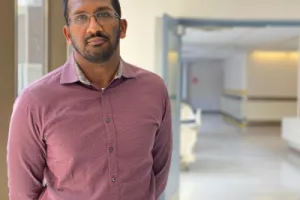
Vignan Yogendrakumar

Vignan Yogendrakumar

MD, PhD, FRCPC

Associate Scientist, Neuroscience

Ottawa Hospital Research Institute

Stroke Neurologist, Division of Neurology

The Ottawa Hospital

Assistant Professor, Faculty of Medicine

University of Ottawa

Tier 2 Canada Research Chair in Stroke

Contact

Wendy Lamont Clinical Administrative Assistant 613-761-4709 (Patient related inquiries)

Administrative Coordinator: Jennifer Brownrigg | jebrownrigg@ohri.ca | 613-737-8899 x73810

Bio

Dr. Yogendrakumar is a Stroke Neurologist at the Ottawa Hospital, an Assistant Professor with the Faculty of Medicine at the University of Ottawa, and an Associate Scientist with the Ottawa Hospital Research Institute.

Dr. Yogendrakumar received his MD from the University of British Columbia, completed his residency in Adult Neurology at the University of Ottawa, and completed both a stroke fellowship and PhD at the University of Melbourne. Dr. Yogendrakumar is an emerging international leader in hyperacute stroke research with a specific interest in thrombolysis and neuroimaging. His work has garnered him several notable awards, including the European Stroke Organization Young Investigator Award, the Paul Dudley White International Scholar Award, and a Canadian Institute of Health Research Fellowship.

Research Goals and Interests

  • Ischemic Stroke
  • Hemorrhagic Stroke (Intracerebral Hemorrhage)
  • Pre-Hospital and Hyperacute Management of Stroke
  • Advances in Neuroimaging

Stroke is a leading cause of death and disability worldwide. While advances in stroke care now allow for more effective treatment of patients who present emergently to hospital, there remains a need for new therapies and improvements in treatment delivery. Dr. Yogendrakumar’s research program aims to develop and evaluate cutting-edge therapies for acute stroke. Using a combination of prospective data collection, advanced imaging analysis, and translational research methods, Dr. Yogendrakumar’s research will investigate the following major areas:

1. Evaluating and Developing Novel Thrombolytic Therapies for Ischemic Stroke
In ischemic stroke, rapid restoration of blood flow is essential to reduce brain injury. Thrombolytic medications, such as alteplase, have been a mainstay of acute treatment. However, the effectiveness of alteplase is limited in patients with severe strokes due to large clot burden (referred to as a large vessel occlusion). Interest has therefore turned to novel thrombolytic therapies that may be more effective than current lytic treatments. Dr. Yogendrakumar is interested in evaluating the latest thrombolytic therapies through randomized controlled trials and is passionate in improving our understanding of clot composition through cutting edge translational research.

2. Innovative Treatment Options for Hemorrhagic Stroke
Although they comprise only 10-30% of all stroke events, hemorrhagic strokes cause more death and disability than ischemic strokes. Almost half of patients die within the first month and survivors are often left with life-long disability. In the absence of effective treatments, current hemorrhagic stroke management is limited to supportive care on stroke units and control of blood pressure. Dr. Yogendrakumar's research program aims to evaluate novel methods to treat hemorrhagic stroke, including minimally invasive surgery and bundled care models.

3. Improving Pre-Hospital Care for Stroke
While the majority of Canada’s population lives within urban centres, a significant portion also live within rural or semi-rural areas. Stroke centers in smaller communities can provide treatments such as thrombolysis, however, critical treatments such as endovascular therapy or imaging technologies, such as CT perfusion, are often not available. Through implementation research initiatives, Dr. Yogendrakumar will work with local stakeholders to identify the gaps in acute stroke care that exist for rural patients and then explore how telemedicine and portable imaging technologies could be implemented and appropriately scaled to address these inequities. The efficacy and safety of these initiatives would be formally evaluated using carefully designed studies. 


News


Publications

Efficacy of Tenecteplase in Large Vessel Occlusion Stroke Within 24 Hours of Symptom Onset: The ETERNAL-LVO Randomized Controlled Trial

2025-12-01 Go to publication

Mortality in ischaemic stroke patients without standard modifiable risk factors: An analysis of the Riksstroke registry

2025-09-01 Go to publication

Endovascular Thrombectomy for Ischemic Stroke With Large Infarct

2025-06-01 Go to publication

Association of Ischemic Core Hypodensity With Thrombectomy Treatment Effect in Large Core Stroke: A Secondary Analysis of the SELECT2 Randomized Controlled Trial

2025-06-01 Go to publication

Spot Sign in Intracerebral Hemorrhage: Critical Reappraisal and Future Clinical Implications

2025-06-01 Go to publication

Related Research at The Ottawa Hospital