John Ngsee
Ph.D.
Affiliate Investigator, Neuroscience
Ottawa Hospital Research Institute
Associate Professor, Cellular and Molecular Medicine
University of Ottawa
Contact
613-562-5800 x2251
Cellular and Molecular Medicine University of Ottawa 451 Smyth Road, RGN 2442 Ottawa, ON, Canada, K1H 8M5
Bio
Education:
1972-76 B.Sc. (Honours) in Physiology, University of British Columbia
1976-78 M.Sc. in Physiology, University of British Columbia, Dr. Nadine Wilson
1981-86 Ph.D. in Biochemistry, University of British Columbia, Dr. Michael Smith
Research Experience:
1986 Postdoctoral fellow, Pathology, University of British Columbia, Dr. Shirley Gillam
1987-93 Postdoctoral fellow, Molecular and Cellular Physiology, Stanford University, Dr. Richard H. Scheller
1993-present Senior Scientist/ Associate Professor, Ottawa Hospital Research Institute, University of Ottawa
Research Goals and Interests
Disruption of protein trafficking is the molecular basis of many human hereditary and degenerative diseases. Research in my laboratory is focused on elucidating the molecular components of these protein sorting and vesicle trafficking machineries. The endoplasmic reticulum (ER) is the first entry point to the secretory pathway for secretory and membrane proteins. The ER exerts a quality control role to ensure that only properly folded proteins are allowed to progress to the Golgi complex. These properly folded proteins are sequentially moved from one membrane compartment to another by transport vesicles. They are loaded as cargoes into transport vesicles along with regulatory proteins that are required for their delivery to the intended target organelle. We have previously used a molecular approach to identify a novel protein which named Prenylated Rab Acceptor (PRA) that regulates an early transport step. We also identified a previously known protein, called VAMP-associated protein (VAP), and found that VAP regulates loading of protein cargoes into transport vesicles. There are two VAP genes in human known as VAPA and VAPB. A single amino acid substitution in VAPB causes a late-onset, familial form of Amyotrophic Lateral Sclerosis (commonly referred to as Lou Gehrig's disease). Mutant VAPB forms insoluble aggregates that cause the ER to form large membrane structures that trap protein cargoes moving through the secretory pathway. Our research focuses on the molecular mechanisms by which mutant VAPB induces formation of these large membrane structures, and ways to mitigate the cellular effects of these structures.
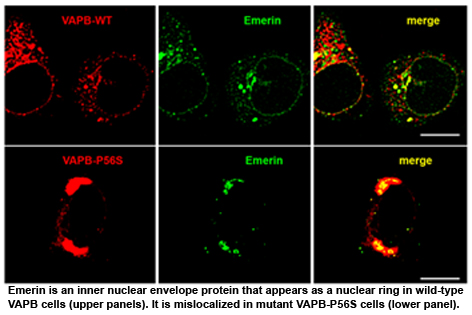
We recently found that expression of mutant VAPB also causes a nuclear envelope defect due to retention of nuclear envelope and pore proteins in the abnormal membrane structures generated by mutant VAPB (Fig. 1). VAPB is required for final delivery of nuclear pore components to the nuclear envelope. This not only highlights a new mechanism by which proteins reach the nuclear envelope, but the progressive deterioration of nuclear pores in the absence of VAPB also provides a mechanism for the age-dependent onset of ALS. Damage or natural deterioration of pore components is a hallmark of age-dependent human diseases. This age dependent deterioration is partly due to the very low turnover of some pore proteins, and synthesis of new pores only occurs shortly after cell division. Together, this renders non-dividing cells, such as neurons, more susceptible to age-dependent deterioration of the pores. Loss of VAPB function further reduces the cell’s ability to make new pores or replace damaged pores, leading to enhance rate of deterioration. Our current research seeks to elucidate the molecular mechanism of mutant VAPB-induced disruption of transport to the nuclear envelope and to design reagents that can restore pore transport to the nuclear envelope.