

Jess Fiedorowicz
MD, PhD
Senior Clinician Scientist, Neuroscience
Ottawa Hospital Research Institute
Head and Chief, Department of Mental Health
The Ottawa Hospital
Professor and Tier 1 Clinical Research Chair in Bipolar Disorders and Metabolism, Department of Psychiatry
School of Epidemiology and Public Health
Contact
(613) 798-5555, ext 72210
Research Groups

Hatching Ideas Lab
Bio
Jess Fiedorowicz is Head and Chief of the Department of Mental Health at the Ottawa Hospital and a Professor and Tier 1 Clinical Research Chair in Bipolar Disorders and Metabolism at the Faculty of Medicine at the University of Ottawa with primary appointment to the Department of Psychiatry and cross-appointment to the School of Epidemiology and Public Health. He is a senior scientist in the Neuroscience Program of the Ottawa Hospital Research Institute (OHRI) with cross-appointments to the University of Ottawa Institute of Mental Health Research (IMHR) at the Royal and membership in the University of Ottawa Brain and Mind Research Institute. He serves on the executive committee of the Brain-Heart Interconnectome. Outside of his roles in Ottawa, he chairs the Scientific Advisory Committee on Mental Health Disorders for Health Canada and is a member of the U.S. Food and Drug Administration’s Psychopharmacologic Drugs Advisory Committee.
His research focuses on morbidity and mortality in bipolar disorder with an emphasis on cardiovascular disease and suicide. He is involved in several clinical trials in bipolar disorder and serves as lead investigator for the Ottawa site of the BD2 Integrated Network.
His methods expertise is in quantitative methods in epidemiology. He values taking an interdisciplinary, team science approach to his work and has over 200 peer-reviewed publications. Clinically, he is board certified in psychiatry by the American Board of Psychiatry and Neurology and in obesity medicine by the American Board of Obesity Medicine.
Research Goals and Interests
The Candesartan Adjunctive Bipolar Depression Trial (CADET): The Candesartan Adjunctive Bipolar Depression Trial (CADET) is a multi-site, double-blind, randomized, placebo-controlled, 16-week trial to study the efficacy of adjunctive candesartan 16 mg/day compared to placebo for the treatment of bipolar depression. Candesartan was identified through an atheoretical stem cell-based drug discovery platform and validated in replicated preclinical and epidemiology trials. CADET will investigate the role of blockade of the angiotensin system in bipolar depression with the potential to repurpose candesartan as a novel and effective neurotherapeutic agent. The CADET study is a publicly funded, Phase 2/3 drug repurposing clinical trial, and registered on the Australian New Zealand Clinical Trials Registry (ACTRN12620000703909). RECRUITMENT PENDING.
BD2 Integrated Network: The BD2 Integrated Network combines a longitudinal cohort study with a learning health network. The multi-site longitudinal cohort study collects data from partner sites across the US and Canada to conduct the largest and most comprehensive prospective longitudinal study ever conducted for bipolar disorder; it seeks to recruit 4,000 participants across 11 sites and follow these participants over the course of five years. Each site will collect blood samples, MRI scans, and cognitive assessment data at regular intervals in order to assess study participants and to better understand the clinical, neural, and biological features of the disorder. This study has the potential to generate new hypotheses and provide direction for future studies. Participating sites also design and implement a learning health network in bipolar disorder to improve care for patients through evidence-based approaches. The Ottawa site is funded by the Breakthrough Discoveries for thriving with Bipolar Disorder (BD2) organization in partnership with Brain Canada RECRUITMENT ONGOING.
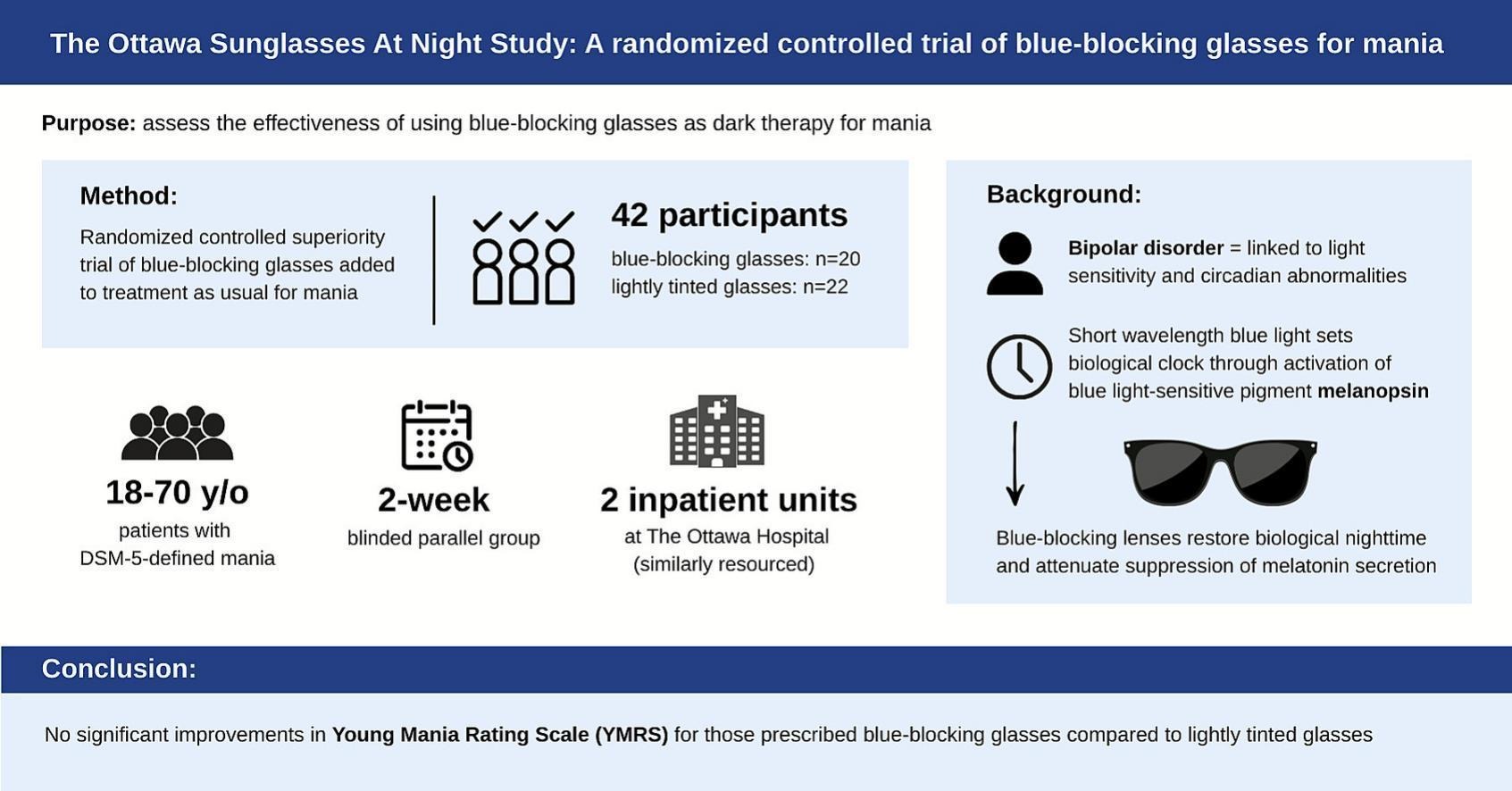
Bipolar mania and blue-blocking glasses: Bipolar disorder is hallmarked, in part, by episodes mania – often severe enough to require hospitalization until symptoms stabilize, usually with medication. These episodes of mania have effects on patients’ finances, relationships, and jobs. In addition, the medication used to treat bipolar disorder comes with significant side effects, which can influence the willingness of patients to adhere to their prescribed medication regimens. Other kinds of interventions have been proposed as adjunct therapies to address separate aspects of bipolar disorder, such as the effects manic episodes have on the circadian rhythm. Both blue light-blocking glasses and time-restricted eating (TRE) are avenues that may reset the disrupted circadian rhythm, which could reduce manic symptoms, shorten manic episodes, and improve overall outcomes. Blue-blocking glasses have been used in two trials led by Dr. Fiedorowicz:
OSAN (Ottawa Sunglasses At Night): This clinical trial involved inpatient participants wearing either the experimental blue light-blocking glasses or the lightly-tinted control glasses. Both the participants and the clinician raters assigned to administer clinical evaluation measures were blinded as to which arm participants were randomized into. This study used the Young Mania Rating Scale (YMRS) to determine whether or not blue-blocking glasses were effective in reducing manic symptoms. This study also used actigraphy to determine what (if any) changes the experimental blue-blocking glasses had on participants’ circadian rhythms and sleep quality. There were no significant improvements in YMRS scores or sleep measures when comparing the study arms to one another. OSAN is registered on ClinicalTrials.gov (NCT05206747).
- CiS (Clocks In Sync): This clinical trial is similar to OSAN but added TRE to the study, creating three study arms: lightly tinted glasses with TRE, blue-blocking glasses with TRE, and blue-blocking glasses without TRE. This trial also used actigraphy data to assess changes in circadian rhythm. CiS is registered on ClinicalTrials.gov (NCT06504342). RECRUITMENT COMPLETE, ANALYSIS IN PROGRESS.
- Mindful Heart: Mental disorders including depression, bipolar disorder, schizophrenia, and psychosis are linked to heart disease, with some of these conditions linked to nearly doubling the risk. Doctors often use risk calculators to inform treatment of heart disease by prescribing medication or suggesting lifestyle changes. This research will develop a risk calculator for heart disease that considers mental health disorders and intersectional factors (sex, ethnicity, socioeconomic status) by using data from a Canadian database – the Canadian Longitudinal Study on Aging. Prior to developing the calculator, we will survey primary care providers about the clinical accessibility of variables and barriers/facilitators of risk calculator usage in order to better design the model. Finally, we will interview primary care providers after model development to their perspectives about acceptability, and feasibility of the developed risk calculator. This work has many applications to improve health care. Early and accurate risk prediction could lead to better patient outcomes, increasing life expectancy and possibly reducing the burden of heart disease on the healthcare system. PhD student: Sara Siddiqi
News



Publications
Do suicide attempts increase in severity or frequency across repeat attempts?
2026-10-01 Go to publicationMetabolic Burden and Response to Repeated Intranasal Esketamine in Treatment-Resistant Depression: A Longitudinal Multidomain Biomarker Study
2026-09-07 Go to publicationPositive Psychological Well-Being and Determinants of Social Robot Acceptability Among Patients With Heart Failure: Cross-Sectional Questionnaire Study
2026-06-02 Go to publicationPsilocybin retail stores in Canada: Changes in availability, commercialization, and geographic distribution
2026-03-19 Go to publication