Research reveals when Duchenne muscular dystrophy starts and supports possible new treatment approach

Duchenne muscular dystrophy (DMD), a rare inherited disorder, usually begins with mild muscle weakness between the ages of three and five, progressing to more severe problems and eventually death around age 30.
New research from Dr. Michael Rudnicki’s team at The Ottawa Hospital and the University of Ottawa shows that at the cellular level, signs of the disease appear much earlier – even before birth. Published in Nature Communications, this research also supports the potential of a novel drug candidate developed by Dr. Rudnicki and Satellos BioScience to correct the problem. This drug candidate, called SAT-3247, targets the AAK1 protein and is currently being tested in human clinical trials.
“These findings make it abundantly clear that Duchenne begins as a failure of muscle stem cells to build and maintain muscle - without any evidence of myofiber fragility or damage,” said Dr. Rudnicki, senior scientist at the Ottawa Hospital Research Institute (OHRI), professor at the University of Ottawa and founder and Chief Discovery Officer at Satellos. “By modulating AAK1, we have demonstrated a powerful means to normalize stem cell function and enhance muscle formation in dystrophic models, pointing to a compelling path toward regenerative treatment strategies.”

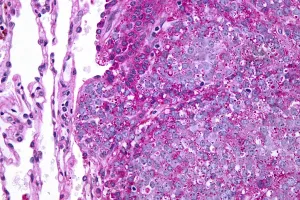
Dr. Rudnicki’s lab studies how muscle stem cells give rise to muscle fibres. An image from his team shows muscle stem cells dividing to give rise to myogenic progenitors from left to right. Image courtesy of Derek Hall.
The Ottawa Hospital is a leading academic health, research and learning hospital proudly affiliated with the University of Ottawa and supported by The Ottawa Hospital Foundation. All researchers at The Ottawa Hospital follow a Responsible Innovation Framework for developing and commercializing innovations in a responsible way.
Authors:
Esper ME, Lin AYT, Bennett D, Rudnicki MA.
Funding:
Canadian Institutes for Health Research, US National Institutes for Health, Stem Cell Network, CNMD-INMG Joint Collaborative Research Program, QEII-GSST, OGS, OIRM