

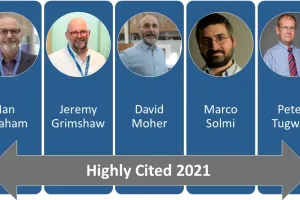
Peter Tugwell
O.C., MD, FRCPC
Senior Clinician Scientist, Methodological and Implementation Research
Ottawa Hospital Research Institute
Director, Centre for Global Health
University of Ottawa
Co-Director, WHO Collaborating Centre for Knowledge Translation and Health Technology Assessment in Health Equity
Bruyere Research Institute
Professor, Medicine
University of Ottawa
Professor, Epidemiology & Community Medicine
University of Ottawa
Contact
(613) 562-6262 x2908
Shannon Hillier cghealth@uottawa.ca
Bio
Dr. Peter Tugwell is Professor of Medicine and Epidemiology & Community Medicine at the University of Ottawa and is a practicing rheumatologist at the Ottawa Hospital. In 2001, he became Director for the Centre for Global Health at the Institute of Population Health. He has built a research program and multidisciplinary team around his Canada Research Chair in Health Equity.
Dr. Tugwell was Founding Director of the International Clinical Epidemiology Network Training Centre at McMaster University [1982-91] and currently serves as Secretary General to INCLEN's North American group (CanUSAClen).
Dr. Tugwell is co-director of a WHO Collaborating Centre for Knowledge Translation & Health Technology Assessment in Equity. Dr. Tugwell is Coordinating Editor of the Cochrane Musculoskeletal Review Group and is Founding Co-convenor of the newly formed Cochrane Health Equity Field/Campbell Equity Methods Group and serves on the Steering Committee of the Campbell Collaboration.
In 2002 he was appointed the North American Editor for the Journal of Clinical Epidemiology. He is also a Section Editor for UpToDate and a member of the Oversight committee of the Canadian Medical Association Journal.
In 2013, His Excellency the Right Honourable David Johnston, Governor General of Canada appointed Dr Tugwell to the rank of Officer of the Order of Canada, the second-highest ranking conferred by Canada. The Officer appointment recognizes a lifetime of achievement and merit of a high degree, especially in service to Canada or to humanity at large. Dr Tugwell was recognized for his contributions as an epidemiologist reducing global disparities in health care access.
Dr. Tugwell's publication record includes over 600 journal articles, monographs, and book chapters.
Research Goals and Interests
The Centre for Global Health
We are a multi-disciplinary team formed to study health inequalities and inequities in Canada and in developing countries in a systematic fashion. Our goals are:
- to study the magnitude and distribution of health inequalities and inequities cross-sectionally and longitudinally;
- to understand and explain the social, structural, psychological, environmental, and behavioural causes of health inequalities and inequities using multi-level and simulation modeling;
- to use simulation models to estimate the costs of health inequalities, health inequities, and potential interventions; and
- to develop multi-faceted interventions to reduce inequities in health and improve the health of the disadvantaged.
Research Programs
Canadian Collaboration for Immigrant and Refugee Health (CCIRH)
The Canadian Collaboration for Immigrant and Refugee Health (CCIRH) is a team of clinicians, public and migration health experts, methodologists, and community health promoters from across Canada dedicated to improving the health of newly arriving immigrants and refugees. The group focuses on identifying neglected preventable and treatable health conditions relevant for immigrants and refugees, conducting high quality evidence reviews, developing clinical preventive recommendations using the GRADE approach, and disseminating our research to primary care practitioners and community based multicultural health brokers.
The goals are: 1) to produce reliable syntheses of evidence to improve quality and delivery of primary health care for immigrant populations; 2) to develop evidence based recommendations with discussions of implementation issues to assist practitioners in population- tailored practice checklists and practice routines; and 3) to support community based health brokers who often play a key role in advising new immigrants in terms of preventive services.

Campbell & Cochrane Equity Methods Group
The Campbell and Cochrane Equity Methods Group is registered with both the Campbell and Cochrane Collaborations.
The Cochrane Collaboration's purpose is to ensure that relevant, accurate, and current research about health interventions is available worldwide. To meet this objective, Cochrane contributors conduct and distribute systematic reviews. Similarly, the Campbell Collaboration produces reviews with an aim to "help people make well-informed decisions about the effects of interventions in the social, behavioral and educational arenas."
The Equity Methods Group encourages authors of both Campbell and Cochrane reviews to include explicit descriptions of the effect of the interventions not only on the whole population but to describe their effect upon the disadvantaged and/or their ability to reduce socio-economic inequalities in health and to promote their use to the wider community. Ultimately, this will help build the evidence base on such interventions and increase our capacity to act on the health gap between rich and poor.

Cochrane Musculoskeletal Group
The Cochrane Musculoskeletal Group (CMSG), a specialized group of researchers, health-care professionals and consumer representatives, belongs to the Cochrane Collaboration, an international organization that prepares, maintains and promotes reviews of the effects of health care treatments.
The CMSG produces reliable, up-to-date reviews of interventions for the prevention, treatment or rehabilitation of musculoskeletal disorders in the form of systematic reviews. Each systematic review is a synthesis of all known published controlled clinical trials and gives the best estimate of health benefits and side effects of a particular therapy.

The Campbell International Development Coordinating Group (IDCG)
The Campbell International Development Coordinating Group is an international network of researchers, policy makers and practitioners who are interested in systematic reviews for better evidence-based international development policy and practice. The Group prepares, updates and disseminates systematic reviews of high policy-relevance with a dedicated focus on social and economic development interventions in low and middle income countries

OMERACT
The Outcome Measures in Rheumatology (OMERACT) initiative is an informal international network of working groups and gatherings interested in outcome measurement across the spectrum of rheumatology intervention studies.
OMERACT 12 was held in Budapest, Hungary from 7 - 10 May 2014.

News


Publications
Disease-modifying antirheumatic drugs (DMARDs) for rheumatoid arthritis after failure of biologic or targeted synthetic therapy: a systematic review and network meta-analysis
2026-07-13 Go to publicationStandardising socio-demographic data collection in pain research: Introducing consensus recommendations for a minimum dataset
2026-02-01 Go to publicationPrinciples and Strategies for Interest‐Holder Engagement in Health Guideline Development
2026-02-01 Go to publication‘Identifying Social Factors that Stratify Health Opportunities and Outcomes (ISSHOOs) in Pain Research’: Explanation and elaboration to support the standardised reporting of equity-relevant data
2025-08-22 Go to publicationIdentifying Social factors that Stratify Health Opportunities and Outcomes (ISSHOOs) in pain research: Consensus recommendations for the collection and reporting of equity-relevant data
2025-07-17 Go to publication