Can AI help 9-1-1 telecommunicators save lives by detecting more cardiac arrests?

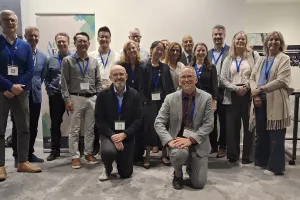
An international team led by researchers at The Ottawa Hospital in partnership with the Ottawa Paramedic Service has received a $1.6 million Cardiac Arrest Team Grant to see whether an AI tool can help 9-1-1 telecommunicators recognize cardiac arrest faster and start CPR instructions sooner, improving survival.
This grant, awarded to Dr. Christian Vaillancourt, was collectively supported through the Cardiac Arrest Research Team Grant funding opportunity, which includes Heart & Stroke, Brain Canada and the CIHR Institute of Circulatory and Respiratory Health.
Every 12 minutes in Canada, someone’s heart stops beating. Sudden cardiac arrest usually happens at home, with family or friends nearby who can call 9-1-1 and start CPR.
Starting CPR immediately is crucial. For every minute without it, the chance of survival drops by about 10 per cent. Unfortunately, CPR is only started half of the time.
CPR is often delayed because a quarter of people with cardiac arrest make gasping or gurgling sounds. These sounds might seem like normal breathing, but the heart has stopped.
Trained 9-1-1 telecommunicators can recognize cardiac arrest based on the caller’s description, and coach them through CPR. A previous study led by Dr. Vaillancourt found these instructions were a powerful tool to increase CPR rates and survival.
However, telecommunicators can also be confused by the gasping sounds. These sounds are responsible for up tohalf of all missed cardiac arrest cases. That means delayed CPR, and a lower chance of survival.
To help solve this, the research team developed an AI system that listens to the words used by 9-1-1 callers and looks for phrases linked to cardiac arrest. For example, callers may say the person is “not breathing right” or “making strange sounds.” The AI does not replace the telecommunicator but supports them by showing how likely cardiac arrest is and explaining why.
The study will test this AI system in several 9‑1‑1 communication centres across Canada. During some periods, telecommunicators will use their usual call‑taking process. During other periods, they will also see AI support on a screen while taking calls. This will show the team how well the AI fits into real work and whether telecommunicators trust and use it.
The team will see whether the AI helps telecommunicators recognize cardiac arrest more often, recognize it faster, and start CPR instructions sooner. The team will also measure bystander CPR rates and survival.
“Early testing suggests this AI-supported approach to spotting cardiac arrest during a 9-1-1 call could improve survival by about five per cent,” says Dr. Vaillancourt, a senior clinician scientist at The Ottawa Hospital and Research Chair in Sudden Cardiac Arrest Resuscitation, Emergency Medicine, at the University of Ottawa. “If our study confirms this and the tool is used across Canada, it could save 2,000 lives per year.”
Research team
Nominated Principal Applicant:
Christian Vaillancourt
Principal Applicants:
Sheldon Cheskes, Venkatesh Thiruganasambandamoorthy, Jim Christenson, Brian Grunau, Steven Brooks, Katie Dainty, Herna Viktor, Monica Taljaard, Shawn Chhabra, Michael Feldman
Collaborators:
Manya Charette, Sarika Naidoo, Lauren Carruthers, Matthew Church, J. Phillip Nicholson, Pouya Khodaee, Wojtek Michalowski, Shannon Leduc, Carolina Malta Hansen, Michael Sayre
Knowledge Users:
Manon Lavergne, Donald Pierce
Core Facilities:
Learn more about:
Media Contact
Amelia Buchanan
Senior Communications Specialist
Ottawa Hospital Research Institute
ambuchanan@ohri.ca
613-297-8315
The Ottawa Hospital is a leading academic health, research and learning hospital proudly affiliated with the University of Ottawa and supported by The Ottawa Hospital Foundation.